
What separation anxiety actually is
There’s a quiet kind of struggle that a lot of dog owners face, one that often stays hidden behind closed doors. It doesn’t always look dramatic at first. It can start as clinginess, a bit of restlessness, or a dog who simply “doesn’t like being left.” Over time, it can grow into something that affects every part of daily life, yours and your dog’s.
This is where I think a lot of people get the wrong end of the stick. Separation anxiety isn’t about a dog being difficult. It’s about a dog who doesn’t feel safe when you’re not there.
Think about a child who panics every time a parent leaves the room. You wouldn’t call that naughtiness, you’d recognise it as distress. Dogs are no different.
It’s also a lot more common than most owners think.
A 2022 UK study of over 1,800 pet dogs, by the University of Liverpool working with Dogs Trust, found that around one in five showed at least one sign of separation related behaviour, before anything about lockdown routines had even started to change things.
If your dog struggles when you leave, you’re not dealing with something rare or unusual. You’re dealing with something I see often, and something that responds well to the right support.
Signs of separation anxiety in dogs
Separation anxiety can show up in different ways, and not every dog shows all of them:
- Vocalising, barking, whining or howling
- Destructive behaviour
- Pacing, or being unable to settle
- Toileting indoors, even in a fully house trained dog
- Following you constantly, or seeming unable to relax when you’re home
Beyond the behaviours themselves, the real cost is emotional, for the dog and for you. For your dog, it’s a more or less constant state of unease. For you, it’s often restriction, guilt and exhaustion, on top of whatever the practical fallout looks like.
Winston’s story
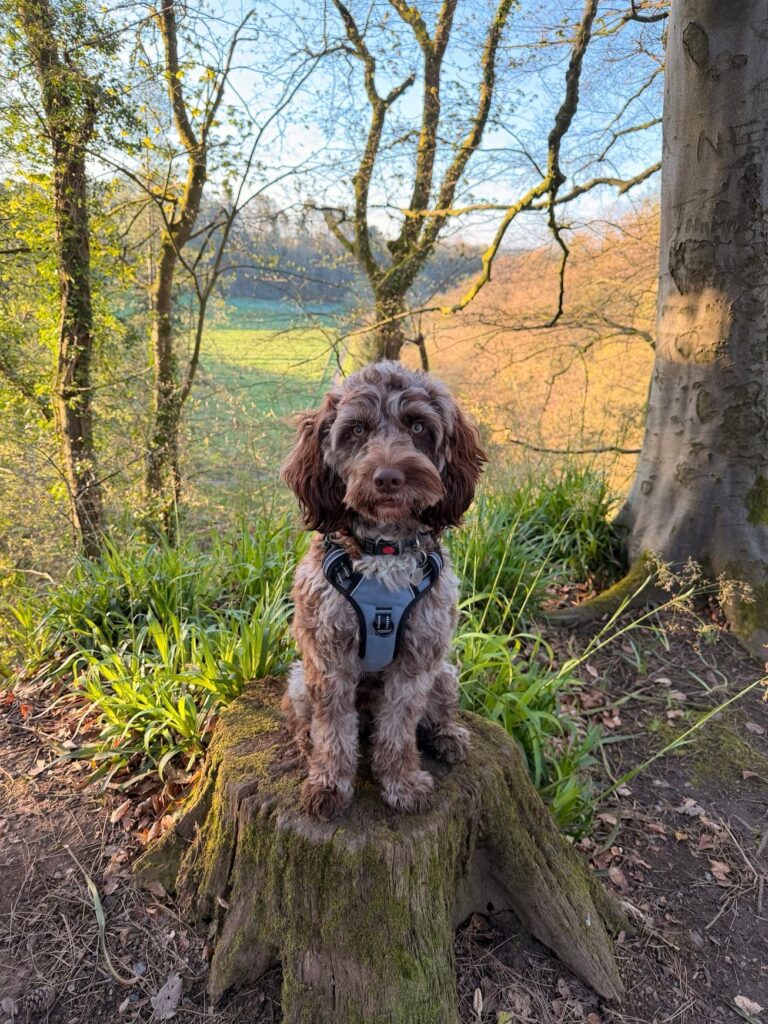
Winston is a young Sproodle, bright, affectionate, the kind of dog everyone warms to instantly.
Behind that lovely temperament, though, was a growing struggle that was starting to take over his world, and his family’s.
His parents couldn’t leave the house together. Work had to be carefully staggered so someone was always home. Even a trip to the shops or a meal out meant arranging a sitter. Their lives weren’t really their own.
And Winston wasn’t coping either. Left alone, he became genuinely distressed, not “a bit unsettled.” That distress didn’t stay confined to the house. Out on walks, he was reactive and unsettled too, his focus scattered, his recall unreliable. What should have been enjoyable outings had become stressful for everyone. He wasn’t being naughty, he was overwhelmed.
At home, whenever his parents were working, Winston sought attention constantly, nudging, pawing, getting into mischief just to draw them back in. Not because he was demanding. Because he didn’t feel secure being on his own.
What actually helped
When Winston’s family came to me, I was honest with them from the start. There was no quick fix and no shortcut. What worked was structure, consistency and clear guidance, built up gradually.
The core of it is what’s often called graduated absence work, helping a dog build tolerance to being alone in small, manageable steps, rather than expecting them to cope with a full day apart straight away.
It sounds simple written down. In practice it takes patience, and it only works if it’s followed properly rather than dipped in and out of.
Winston needed around 8 sessions, spread over a few months. Because every dog is different, I always deal with the individual dog. That way, no one feels pressured by expectations.
Winston’s family followed the plan as I set it out, session after session, without second guessing the process. That mattered. Meaningful change doesn’t come from trying a bit of everything, it comes from doing the right things, consistently, over time.
Fairly quickly, Winston began to feel safer. Time alone was introduced in a way he could actually cope with, and his independence was built carefully rather than forced. As that underlying panic eased, his neediness at home reduced too.
Something else shifted as well. Without that constant background stress, Winston could focus properly on walks. He became calmer, more connected, and far more responsive, and his recall improved because his brain wasn’t stuck in survival mode any more. Walking became what it should have been all along, relaxed and easy.
I have never been so excited to receive a message than when I received an update from Winston’s parents: they had actually made it out for breakfast!
Its life changing when we can have a dogs who is settled on their own.
Today, Winston’s parents can leave the house together. They can go shopping, go for a meal, even head to work for a few hours, without worry. Not because he’s been trained to tolerate it, but because he actually feels safe on his own.
He settles, he rests, he’s at ease. On walks, he’s calm, attentive and reliable.
It took a clear plan, followed properly, and a family willing to stick with it, even on the harder days.
If your dog struggles when you leave
I work with owners across Ayrshire, East Kilbride and Glasgow South Side, in person and online, to help dogs like Winston feel safe being left alone. If your dog struggles when you go, it’s not something to ignore or hope they’ll grow out of. It’s something to understand and address properly.
You can find out more about how I approach this on my separation anxiety support page, or get in touch using the contact form below for an honest conversation about where to start.
Frequently asked questions
Is my dog just being naughty, or is it separation anxiety?
Almost always, it’s not naughtiness. Destructive behaviour, barking, or toileting indoors when a dog is left alone are usually signs of genuine distress, not defiance. A dog behaving this way is struggling to cope, not misbehaving.
How long does it take to help a dog with separation anxiety?
It varies from dog to dog, and I won’t promise a fixed timescale, anyone who does is overpromising. What I can say is that with the right plan followed through properly, most dogs do make real progress, as Winston did.
Can separation anxiety affect a dog’s behaviour on walks too?
Yes, quite often. A dog carrying constant background stress from struggling at home can also seem reactive, distracted or hard to focus on walks. Addressing the anxiety at its root, rather than just managing the walk itself, often improves both.
When you support a dog in feeling safe
Separation anxiety can feel overwhelming when you’re in the middle of it. It can shrink your world and leave you unsure what to do next. Winston’s story is proof that things can change, with the right approach and the willingness to see it through.
When you help your dog feel genuinely safe, the rest tends to follow.