
Moving into the senior years
There isn’t a single age at which every dog becomes senior.
Ageing is influenced by factors including size, genetics, health and the individual dog, and the changes associated with ageing happen gradually rather than appearing on a particular birthday.
That’s why I think it is more useful to notice changes in the dog than become too fixated on a number.
Perhaps walks are becoming slower. Your dog hesitates before jumping into the car. They take longer to get comfortable in bed or seem less keen to negotiate stairs.
Individually, these changes can seem insignificant.
Together, they may be telling us that our dog’s needs are beginning to change.
How ageing can change your dog
When we think about ageing, we often picture stiff joints and slower walks, but ageing can affect much more than mobility.
Vision and hearing may gradually decline. Muscle strength can reduce, arthritis may develop and dogs may need longer to recover after physical activity. Age-related changes can also affect the brain, influencing memory, sleep and the way dogs process information.
The difficulty is that these changes rarely happen overnight.
We adapt alongside our dogs.
Perhaps you stop walking quite as far because your dog seems tired. You lift them into the car because they’ve stopped jumping in. You avoid a particular route because they seem reluctant to climb the hill.
Before long, these little adjustments become normal, and it can be surprisingly difficult to remember how much has actually changed.
That is why noticing your dog’s individual normal is so valuable.
Why behaviour changes in older dogs matter
As a behaviourist, one of the most important messages I can give owners of older dogs is this:
Don’t automatically dismiss behavioural change as old age.
A dog who suddenly seems grumpy may actually be uncomfortable. A dog who no longer wants to jump into the car may not be stubborn; jumping may hurt. A previously relaxed dog who starts startling when approached may not have heard someone coming.
Pain doesn’t always look like limping.
Sometimes it looks like reluctance. Irritability. Restlessness. Withdrawal. Difficulty settling. Becoming less tolerant of touch or increasingly worried about situations the dog previously managed comfortably.
If I see a significant behavioural change in an older dog, particularly when there is no obvious environmental explanation, a veterinary assessment is one of my first recommendations.
Behaviour is information at every stage of life.
In our senior dogs, we need to listen particularly carefully.
Sleep and restlessness in senior dogs
Changes in sleep can occur for several reasons as dogs age.
Pain may make it difficult to find a comfortable sleeping position. Changes in hearing or vision can affect confidence, and some older dogs develop cognitive changes that affect their sleep-wake cycle and orientation.
You may notice pacing, waking during the night, staring into space, appearing confused in familiar surroundings or becoming increasingly unsettled when separated from you.
These changes deserve investigation rather than simply accepting that old dogs don’t sleep as well.
There are medical conditions that can affect sleep and behaviour, and some dogs develop canine cognitive dysfunction, sometimes described as a dementia-like condition in dogs.
Early veterinary assessment gives you the best opportunity to identify what is happening and discuss whether anything can be done to make your dog more comfortable.
Adapting your home for an older dog
Supporting a senior dog doesn’t always require dramatic changes. Sometimes relatively small adjustments make an enormous difference.
Slippery flooring is a good example. A dog whose strength or stability is declining may begin moving cautiously across laminate or tiled floors. Adding non-slip runners or mats can give them considerably more confidence.
Think about the journeys your dog makes every day.
Can they get comfortably in and out of bed? Can they reach the garden without negotiating difficult steps? Are they still able to get into the car safely? Can they stand comfortably while eating and drinking?
Supportive bedding, non-slip flooring and ramps or steps where appropriate can all help, depending on the individual dog.
The aim isn’t to remove independence unnecessarily.
It is to change the environment so they can keep as much independence as possible.
Exercise in the senior years
Growing older doesn’t mean exercise should disappear.
Appropriate movement helps support mobility, muscle strength and general health, but the emphasis often needs to shift from distance and intensity towards comfort and enjoyment.
A long walk that leaves your dog stiff or exhausted for the rest of the day isn’t necessarily better than several shorter outings they genuinely enjoy.
And don’t underestimate the value of simply allowing them to sniff.
Your older dog may no longer race through the woods as they once did, but standing quietly while they investigate an interesting scent is still giving them information, stimulation and an opportunity to engage with their world.
Some days they may want to walk further.
Other days they may not.
We need to become comfortable adjusting the plan to the dog rather than expecting the dog to keep up with the plan.
Senior dogs still need enrichment
One of the misconceptions I particularly dislike is that because an older dog sleeps more and moves less, they no longer need much stimulation.
Older dogs are still dogs.
They still have a nose. They still have preferences. They can still learn and make choices, and they still deserve opportunities to do things simply because those things bring them pleasure.
Scent work can be particularly lovely for senior dogs because activities can be adapted to suit changing mobility. Food searches, gentle scent games, simple problem-solving activities, appropriate play and exploring interesting environments at a slower pace can all add richness to their day.
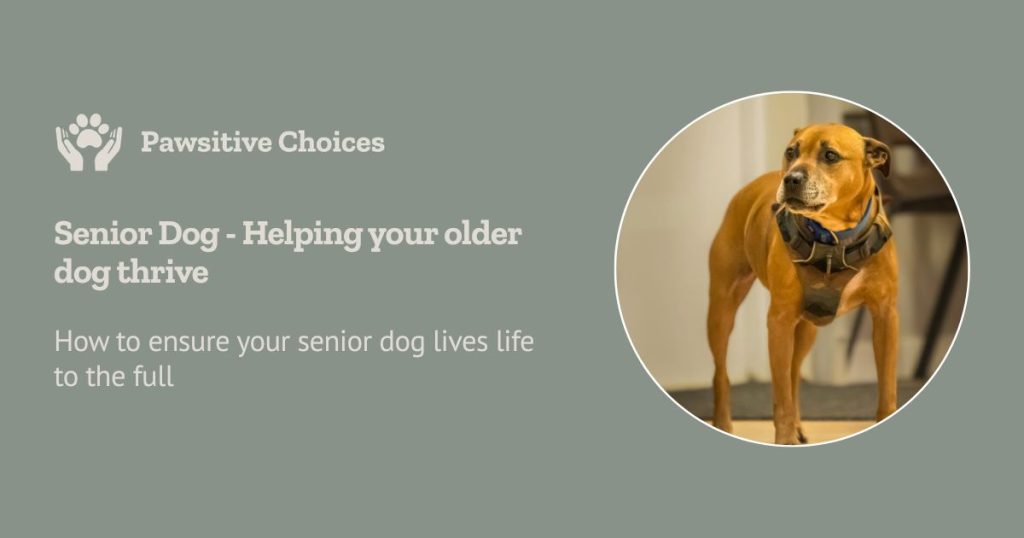
One of the best dogs in my scent class is a 10-year-old called Frank, pictured above. He is every bit as good as his younger dog pals. Find out how scent work can enrich your dog’s life here.
We don’t need to stop doing the things our dogs love simply because they can’t do them in quite the same way.
We adapt them.
Growing older doesn’t have to mean that life becomes smaller.
Why maintaining muscle and a healthy weight matters
Weight becomes particularly important as mobility changes.
Extra weight places additional strain on joints that may already be affected by arthritis or other age-related conditions. At the same time, older dogs can lose muscle mass, and maintaining muscle is important for strength and mobility.
This is one reason I wouldn’t simply assume every older dog needs less food or automatically move them onto a particular diet because the packet says “senior”.
Their nutritional needs should reflect the individual dog.
Regularly checking body condition, monitoring weight and discussing significant changes with your vet can help identify problems early.
If supplements, dietary changes or omega-3 fatty acids are being considered for a particular medical reason, I would also discuss these with your veterinary team rather than simply adding multiple products because your dog has reached a certain age.
Don’t take away everything they love
I think this is an important part of senior care that sometimes gets overlooked.
Once we realise our dog is ageing, it is very easy to become protective.
We stop them doing things because we’re worried they’ll hurt themselves. Walks become shorter, freedom decreases and gradually their world can become increasingly restricted.
Sometimes restrictions are absolutely necessary.
But wherever possible, I would ask a slightly different question:
How can we help them continue doing this safely?
If they can no longer manage a two-hour woodland walk, perhaps they can still enjoy twenty minutes there. We can substitute active ball play with searching for items instead.
We can’t stop our dogs growing older.
But we can make sure ageing doesn’t unnecessarily take away everything that makes their life worth living.
One thing I would encourage every senior dog owner to do
Every few months, take a little time to really observe your dog.
Not the dog you remember from two years ago.
The dog in front of you today.
Watch them getting up from bed. Notice how they use the stairs. Look at how they move at the beginning and end of a walk. Think about their sleep, appetite, toileting, social behaviour and enthusiasm for the things they normally enjoy.
Small changes are much easier to recognise when we deliberately look for them.
You might even keep a few notes or occasional videos. When change happens gradually, having something to compare can be surprisingly useful, for you and potentially for your vet.
Frequently asked questions
My older dog has started following me everywhere. Why?
There can be several reasons. Changes in hearing or vision can make an older dog more dependent on familiar people, while pain, anxiety and cognitive changes can also alter attachment behaviour. A noticeable change in how comfortable your dog is when separated from you is worth discussing with your vet rather than assuming they have simply become clingy with age.
Why has my senior dog suddenly started having accidents in the house?
Don’t assume they’ve forgotten their toilet training. Increased urination, reduced mobility, pain, cognitive changes and several medical conditions can contribute to house-soiling in older dogs. A veterinary check should be the starting point for a previously housetrained dog who begins having accidents.
Can old dogs still learn new things?
Absolutely. Older dogs remain capable of learning. You may need to adapt how you teach if hearing, vision, mobility or cognitive processing has changed, but learning can continue to provide mental stimulation and enjoyment throughout life.
How can I tell whether my dog is slowing down because of age or pain?
It isn’t always possible to tell by watching them, which is why changes shouldn’t simply be attributed to age. Reluctance to jump, difficulty getting up, changes in gait, irritability, increased sleeping or withdrawing from activities can all occur with pain. If you’re unsure, speak to your vet.
Should I walk my senior dog every day?
There is no requirement to achieve a particular distance every day. Appropriate regular movement is generally valuable, but what is suitable depends on your dog’s health and mobility. Some dogs benefit from several shorter outings, and there may be days when a very gentle sniffing walk is quite enough. If your dog has a diagnosed condition affecting exercise, follow your veterinary team’s advice.
Growing older together
Perhaps the greatest gift we can give our senior dogs is our willingness to slow down with them.
The walks may become shorter, but the sniffing can become more meaningful. They may no longer race across fields, but they can still delight in familiar places, favourite activities and the quiet companionship of the people they love.
Our role changes too.
When they were puppies, we helped them discover the world. During adolescence, we helped them navigate it. Throughout adulthood, we enjoyed exploring it alongside them.
Now we begin helping them remain part of that world as their abilities change.
There is something deeply special about this stage of life. The relationship built over all those years is filled with familiarity, trust and shared experience.
Your dog doesn’t need you to stop them growing old.
They simply need you to notice when their world begins to feel a little different and help them continue to enjoy it.